Saturday, October 11, 2014

Have you seen your Gorgon lately? Or is some other animal's head on top instead?

Who would have thought that, at the center of Western ethos, there is a Gorgon,  a Medusa, and her stare or (“devilishly”) blinking look (depending on at which level one is caught) and that this woman’s head might be lacking a body which the headless masses are bringing to her?
If not the foundation of Western civilization, then at least one of its pillars is killing a woman because she was either too ugly/too beautiful or too dangerous or too powerful or because she just knew too much.  

Thomas Louis, Perseus Slaying Medusa

Other cultures and peoples had certainly their share of beheadings, involving humans regardless of sex or gender. However, it takes a certain spirit to build a woman’s murder and beheading into a foundational cultural myth lying at the base of the whole civilization.

Other cultures and civilizations kept women as Gods and among Gods--unless they turned "mono-" with the message:  "OK, you messed up and brought evil to us, so would you now step aside? And can we do it without the word 'please'? Old men can take it from here."

It does take a certain spirit first to remove the divine from nature and oppose it to nature and then remove the feminine from the Godhead as well in order to build the image of God in the image of and to the likeness of an old man whose love of life is either very suspect or is so strong that only everlasting fires of Hell can balance it.

Materialism was an attempt to "solve" this problem by positing the collective womanhood as a substance wiped off any quality and content. Then, beginning with Nietzsche, Freud and Jung, they discovered that this matter is neither dead nor empty, but very dark and apparently very evil and therefore very interesting and attractive, especially if new male priests like them can make something out of it again--like fascism or a "new improved" Jesus by uniting him with the denied fourth (the devil). A big portion of Bulgakov's inside joke was that communist materialists had no clue about the "matter," the spirit hiding in its abyss. So that's part of the reasons why Dugin follows Nietzsche and Heidegger.

The Medusa myth does also tell us what was required before Medusa earned her beheading. First she needed to be turned from a beauty into an ugly horror as a “punishment” for being raped by Poseidon.  There are beliefs that ennoble the human spirit and then there are beliefs that uglify it and make them headless. Deception is a form of beheading. If you want to understand what the Western civilization or capitalism is, start looking for the missing head. For the foundational deception, decapitation, capture.  To know the truth not only requires that one grows one’s head or soul again, but that one also have the courage to see the terrible for what it is.


ISIS is happily posting with a head severed from a Kurdish female fighter near Kobani, Syria. ISIS is a child of al Qaeda, the bastard of Western secret services and special forces. As we see, ISIS is acting out an old Western pagan story. The monster is the one with the finger up.

Alexander Dugin: Trying hard to take the Russian Soul Over the Rainbow into Heidegger's World

AlexanderDugin's take on human nature helps unveil what Dugin means by his Heideggerian Dasein (Man), Man’s “Ground,” which is the “Un-Ground” or just a sheer abyss or Hell, as he argued elsewhere (“Ad-eto gde my”: “Hell is where[ever] we are):” For Dugin, there is no human nature. All that is is socially determined, he argues, and is anti-natural: 
"Because there is nothing natural in man. Man is a completely conditioned creature ... In any case, there is nothing in man that is natural. Everything in him is made. Man makes himself, society makes man."
Thus, for Dugin, man's nature stands for nothing. One of the many problems with this is that denying man's nature (that there is something rather than nothing or something made out of nothing) would not only leave us with a notion that nothing is then true or that the truth is nothing, but it would also nihilate some of the key sources of our dignity and self-respect unless one would be willing to be left with a version of American self-respect that teaches that one is supposedly what one makes oneself to be and that "one can be anything one wants to be"--with the "noble lie" of the American way of life. Whether then one would hold this self-making mainly as ego-centered or society-driven would be then a matter of which form of blindness or abstraction (or lie) one would prefer.
Logically, this position should then make Dugin also reject not only the idea of truth (and pravda or istina, two words for truth in Russian--are for Russians as important as "liberty" is for Americans), but also the soul, unless he would reframe it and redefine it away as nothing but a construct. But if , he would then also need to get away with the idea of the Russian soul--unless again he would take it to be a construct, which, as a construct, would not be ontologically different from other constructs such as a story, a myth, an opinion.
In this light, Dugin's philosophy and his "fourth way" then starts to look more like Heidegger with some constructivism and postmodern epistemology and fashion added to it. And constructivism (everything is just a construct and there is no other truth but what we make it to be) is American ideology par excellence--one that took over pragmatism.
The "overcoming" and "subjugation" of nature, i.e., human nature, simply by denying it or making it to be "nothing" is merely the latest fashion in the long Western tradition in the effort to complete this original religious program from Genesis 1. When one knows little or nothing of the soul, then this prejudice appears as the final perfect solution. Why could not we have thought it before? First nature is posited as the enemy or as the other, then once the enemy is declared to be nothing at all, we have won and reached the acme of "wisdom."
But he also says: "Russia's enemy is our insufficient love." ... And to love weakly means that we don't know ourselves well enough either, that we are not attentive enough to Russia ..."
Врагом России, мне кажется, является слабость нашей любви к нашей культуре. ... недостаточно себя понимаем, недостаточно к своей Родине внимательно относимся, недостаточно русскую традицию знаем, почитаем русское предание и ей следуем.
"А.Д.: Во-первых, естественное стремление человека к комфорту, оно не естественно, а противоестественно, социально предустановленно, потому что у человека нет вообще ничего естественного. Человек это полностью предопределяемое, для христиан духовностью, существо - душой, а для социологов - обществом. В любом случае, в человеке вообще нет ничего естественного. Все в нем создается. Человек сам себя создает, общество создает человека. Это происходит через язык, через воспитание, через культуру."


Paradoxically (?), this Dugin's position is compatible with constructivism, the same liberalism, even with Marxism (on this point), materialism, and also with nihilism. What separates Dugin from these other –isms is his iron-clad attachment to Heidegger (and Carl Schmitt), his geopolitics and his Heideggerian take on Orthodox Christianity. If one had to ask what Heidegger’s existentialism in the interests of the Third Reich might have demanded from the Russians back then or now, one might get the answer from Dugin and his idea of what Russian, Orhotodox Christianity is supposed to mean for such a Heideggerian as Dugin:
"[In the New Testament] St. Paul says: "'Slave, you must serve your master.' That's unjust. But he says that to serve a bad master is still better than serving a good master. ... To love someone who is good is egoism. And Christianity hates such egoism and does not tolerate it in any form whatsoever. ... Such egoism [to love the good] is a sign of our tragic imperfection and, in the end, it is a seal from the devil. And this is the very basis of world liberalism. And that's why [this love of the good] is the most terrible sin in Christiniaty--it is the sin of pride. Thus it is OK to serve a good master, but this is what anyone can do. But to love those who hate you ... this is purely Christian ethics. ... And I deeply believe that Novorossiya [will] stand up against liberalism ..." 

Should not, guided by this teaching, then Dugin try to serve the worst master--the liberals in Moscow or the Nazis in Kiev? For to serve a good cause would then appear to be "sinful," "egoistical" and "Satanic"?

"Апостола Павла, да. Говорится: «раб, служи своему хозяину. Лучше служи плохому хозяину». Вот, это несправедливо. Плохому хозяину, как он предлагает, служить еще лучше, чем хорошему. А апостол Павел говорит: «Даже животные любят своих детей» Тот, кто делает кому-то добро, того и любят. Но это эгоизм. Это эгоизм. А христианство совершенно не терпит эгоизма, ни в какой сфере вообще. Оно ненавидит эгоизм. Оно сожалеет даже, поскольку христианство ничего не ненавидит, оно сожалеет об эгоизме. Оно рассматривает эгоизм как печать, печального несовершенства и, в конце концов, дьявола. Потому что самый страшный грех, это даже не прелюбодеяние, не кража, не убийство, самый главный грех в христианстве – это гордыня. То есть как раз та самая основа, либеральное мировоззрение, гордыня. И поэтому святой, который не совершает никаких грехов, если он возгордиться, он может погубить свою святость. В этом отношении, здесь очень тонкий момент. Христианство – это этика блага, это этика дара безвозмездного. Потому что служить хорошо хорошему хозяину - это любой служит, потому что хозяин поддержит, ты ему служишь. А вот хорошо служить плохому хозяину, любить того, кто тебя ненавидит, молиться за врагов своих, это чисто христианская этика. И я думаю, что наше общество в большей степени холистское – раз, и христианское – два. Оно в корнях своих все равно, православное, христианское, как бы его не пытались превратить в общество антихристианское, то есть, либеральное. И это для меня вопрос веры. Я глубоко верю в свой народ, и тот факт, что Новороссия стоит против либерализма, «либерального быдла». Русские, идут в Новороссию. Отдают жизнь свою «за друге своя». Это признак здоровья, внутренней цельности, мощи нашего народа, и всей нашей большой России.”


Furthermore,  as Dugin explains, he moved from summing up the philosophical and ideological options of humanity from a trinity (liberalism,  communism, and Nazism/nationalism) to a four—the new fourth being his own position informed by Heidegger, which he is, however, presenting as the essence of Russia’s Logos. In order to count till three or now to four, he wrongly counts Nazism and nationalism as part of the same “way.” And, as he explains, in the nineties, he tried to forge a potion-synthesis of “nationalism” (read fascism) and “Bolshevism” under the name of “National Bolshevism,” and this was being introduced by an avowed anti-communist"! whom Dugin always was and still is. So when one is offered a "synthesis" of Nazism and communism from a Heideggerian anti-communist, one should not need to need much IQ to see what is actually going on.

Dugin's new “fourth” is now based on “existential nationalism” (a Heidegger in the place where the Russian soul and spirit ought to be) so that Dugin’s new fourth looks to me much like his previous fourth—just renumbered and rebranded.

"Теперь третья политическая теория, которую можно назвать национализм и крайняя форма фашизма, крайние правые и так далее. Здесь в нашей полиэтнической структуре, в нашей открытой модели русского мира, любое представление о национализме, о необходимости эксклюзии, или утверждении не расового этнического неравенства некто другим, оно просто полностью противоречит русскому духу. То есть принять национализм мы не можем, потому что это идет против нашей собственной, национальной традиции.С.Ш.: - Русский большой народ.
А.Д.: - Русские – большой народ. И мы всегда включали в себя, не исключали никого, включали всех, кто разделял наши установки, наши исторические модели. И в этом отношении, национализм, как третья политическая классическая теория, современности, подходящая для Запада и доминирующая на западе несколько столетий, она просто для нас тоже не подходит. И вот, оказывается, что еще была версия в 90-е, сочетать левых и правых, создать национал-большевистский синтез, это, кстати, на мой взгляд, была продуктивная вещь. И кое что в Новороссии сейчас именно от национал-большевизма и задействуется. Но, если внимательнее посмотреть, то простое механическое сочетание коммунизма и национализма, у которого, есть положительные и отрицательные стороны, все равно не даст нам искомого результата, все равно, это обращение к западному опыту. И тогда возникла идея построить четвертую политическую теорию за пределом всех трех. Ну, и поиск начался с того, что, является субъектом этой четвертой политической теории. Дальше возникла идея, экзистирующего народа, то есть народа, как экзистенциальное понятие. Народа не как совокупность людей, как население, а именно как…"
Читайте далее: http://svpressa.ru/online/article/91585/

When a philosopher is failing to be consistent, his inconsistency raises several possibilities: either he does not exactly know what he is saying (there is an error and contradiction in what he says) or he is lying.

In Dugin’s case—man of “the rainbow,” the one who is to take us over beyond the rainbow (yes, I am trying to make a reference to Eyes Wide Shut and mind-control trance-formation technologies)—we stumble, for example, over this: “A Russian ideology is an ideology that is not coming from the West, but one which is flowing naturally from our live, from our values. And as much as they [we] fight for such values, such as the Russian language, Russian history, Orthodox Christianity, then these values are coming on top.  … These [values] then become principles.”

First, suddenly, Dugin appeals to nature or to what is supposed to be “the natural way of [Russian] ethos [or life]" ("вытекает естественным образом из нашей жизни"). Yet, the same Dugin also told us to discard the idea of nature in this regard for he claims there is none. All is made. So there ought to be no “natural way”—had Dugin chosen to be consistent with himself. 

Second, ideology is a product of the same modernity, which Dugin is so much against. Ideological thinking is a peculiar form of thinking—one, which, as its definition foes, “masks and conceals its own contradictions.” Ideological thinking is, by definition, a product of mass society, it is mass thinking—thinking in terms of readymade ideas and clichés. Dugin then, moreover, lies when he argues that this “Russian ideology” by which he means his ideology “is not coming from the West.” It is coming for most part from Heidegger and Carl Schmitt, the two most essential thinkers of Nazi Germany, whose teaching Dugin is trying so hard to graft unto Russia so that Heidegger’s and Schmitt’s ideas bring Russia closer to the “apocalypse.” 

Third one cannot be a friend of Orthodox Christianity and Heidegger at the same time, as one cannot be a Bolshevik and a Nazi at the same time. Moreover, Dugin himself never tried to hide his anti-communism.

"А русская идеология, это идеология, которая берется не с Запада, а которая вытекает естественным образом из нашей жизни, из наших ценностей. И поскольку они бьются за такие ценности, как русский язык, русская история, православие, то эти ценности и становятся во главе угла. Они их защищают и для них они имеют значение. По-настоящему они становятся принципами." Читайте далее: http://svpressa.ru/online/article/91585/

In his Heideggerian spirit, Alexander Dugin then also tries to redefine Russia and the Russian nation as a whole along Heidegger's lines. He is using Tzvetaeva as his foil, and, as such, he then proceeds to make the following categorical statements: "Russia is death, and since such death in Gnosticism is the beginning of a real life, with the physical bodily existence being a sojourn in a grave, the the country on that other side of life is a country of rebirth and genuine being, a land of Saint Sophia. ... the country of death understands all the languages and thus also the language of the dead."
"Россия и есть смерть, а так как смерть в гностицизме есть начало истинной жизни, а физическое телесное бытие – пребывание в могиле, то страна того света есть страна Воскресения и истинного бытия, страна Святой Софии. ... страна смерти понимает все языки, и русский язык как язык этой страны Смерти есть все-язык, а значит, язык мертвых."
Orthodox Christianity is not Gnosticism. And what Dugin says here is Heidegger ... Dugin just replaced Germany with Russia, and Heidegger is not an Orthodox Christian. Leaving that aside, I don't think that one can really pretend with a serious face that either Heidegger or Gnosticism is "Russian logos" or the "Russian soul" or that the idea presented above can or should really be the philosophical program--a "philosophy" of death--to motivate and inspire Novorossiya's soldiers.

What can a Novorossiya soldier, a Strelkov's man, teach all of us, including a Platonist with a Ph.D.?

Strelkov's comrade in arms from Slavyansk with a name de guerre Sever (North) speaks his mind. Among other things, he says that there has not been a better system than Soviet socialism. Why? Two things: 1) everyone had a work, and the right to work was the grounding of man's dignity, 2) related to that was Soviet socialism's early achievement (as opposed to its officially "developed" or decadent and dying form) encapsulated  in the slogan and greeting: "Honor to work."

Honor, a virtue, previously a supposedly aristocratic value, had been won by the people.  This concept of honor was and is very different from the liberal/bourgeois or American sense of "being special" whereby one caresses one's ego/egoism.

The Soviet sense of honor was tied (horror of horrors!) to the common good: "Everyone is free to win honor if s/he serves the common good according to one's abilities." To achieve honor meant to serve the common good. Part of this agon for honor was for men to serve in the army. In other words, what was truly animating the system and giving it its energy, life, and purpose was a moral, ethical idea of the intertwined notions of honor and the common good.

When Soviet leadership and bureaucracy became dead to the idea of honor and the common good--hence to the idea of the good, the system started to die and stink from the head down. For, in this way, the leadership, as opposed to the majority of the people in the Soviet Union, died to what was making the system alive.

Fighting for Novorossiya and thus also for the Russian nation's rebirth, Sever has won his honor back. The struggle of Novorossiya is bringing honor back to people who were and are treated by oligarchs and Ukrainian Nazis as their supposed slaves. Strelkov's men and women are bringing the idea of honor and the common good back to life.  They are bringing Russia back to life.

Meanwhile, oligarchic Moscow tries to strike a deal with Kiev's Nazis in order to avoid all this. They want to remain feeling "special" as "partners" of the Empire.


Wednesday, October 8, 2014

Alexander Zakharchenko and Akhmedova, a "Russian Reporter": A Faustian Deal-Maker and Master Margarita

Alexander Zakharchenko gave an interview to Marina Akhmedova from Expert Online/Russian Reporter, which Zakharchenko clearly intended as one of his key PR performances in his and his backers for the post of the DPR president, but, which thanks to Zakharcenko himself and the selected reporter, only serves to show the so-called fifth column at its game so that even the word "fifth" looks more and more like a placeholder for a different word, yet almost the same but for one letter in the middle. http://expert.ru/russian_reporter/2014/39/nachalnik-donbassa/

So first let's meet the journalist to whom Zakharchenko spoke to. Marina Ahmedova. Works for Russian Reporter and what could be more Russian than a reporter that is called Russian?

In one of her previous interviews, "What Strelkov, Bes, and Others Believe and What They Are Fighting For" (July 31), Akhmedova is attributing to a local militiaman who "did not, did not give his name," a statement that Boris Bezler, the commander of Gorlovka, is "a psychologically sick person." Akhmedova then offers a statement emphasized in the text in bold fonts, in which she reframes the Odessa massacre simply as "a fire" and asserts: "In Odessa, they already forgot about the fire. People live a peaceful life there." She then finishes her interview with a Ukrainian officer in Slavyansk whom she quotes as saying that captured militiamen "don't want to accept responsibility" because their reasoning is slow--they cannot even organize themselves to be led for a "lunch" supposedly offered to them by the Ukrainian army. The title of the article, as indicated, is a question her answer to which Akhmedova craftily puts into the https address of the article: "A child's tear is no longer worth anything." That's who she is summing up the supposed cause of Novorossiya. http://expert.ru/2014/07/31/sleza-rebenka-bolshe-nichego-ne-stoit/

In his article from October 2, "To save the country's soul," Akhmemdova explains her mission and the meaning of the title right at the beginning: "The goal is one--to expel war from our soul and heart [so that the Minsk] truce would change from fragile to reinforced concrete." She then reports on her discussion with Ukrainian POWs from the 39th territorial defense Dniepropetrovsk battalion who, as she writes, told her that they were captured by a Russian regular army unit. http://expert.ru/russian_reporter/2014/38/spasti-dushu-stranyi/

In other interview, she presents this particular exchange: "Can the army be afraid of the militia? --When five people are chasing a rat and when they corner her, she could become dangerous to any of them." She then adds speaking to several Strelkov's soldiers from Slavyansk: "If you had not gotten out of Slavyansk and had you not occupied Donetsk, there would have been as many victims and shelling." Later, in a different conversation, she suggests again that, by raising arms, the militia was "endangering local people." Again, Akhemedova's intended message is in her title: "We will be later ashamed of this war." Listenihttp://expert.ru/russian_reporter/2014/31/za-etu-vojnu-potom-budet-styidno/

After listening to her, a local at last says to Akhmedova point-blank: “You know, you are asking such strange questions [some of them of military character] that people in the town started to doubt whether you are  a Russian journalist.” http://expert.ru/2014/05/8/muzhiki-i-lenin/
So, now we come to Akhmedova’s “election campaign” interview with Alexander Zakharchenko.  The title of the interview is “Chief [i.e. Chieftain] of Donbass.”  This half-ironic, half-mocking twist sets the tone.  Before she gets to ask political or military questions, she asks the aspiring leader of the Donetsk Republic: “About what were you crying as a child?” “A car ran over my dog. I cried a lot,’ [Zakharchenko] unhappily laughs.” After that, Akhmedova takes the reign of the discussion even more firmly into her hands and starts “teaching” Zakharchenko about politics of Russia, as she sees it. When Zakharchenko says that Ukraine “changed people’s psyche and made slaves from formerly proud Slavs.” 

At one point, Zakharchenko then understood that the system treats them and sees them as slaves. To this Akhmedova retorts: “And do you think that, in Russia, people are treated differently?” And she lets Zakharchenko reply: “No , I don’t  … I say even more.  The mistake of Russia is that many of you—Russians [like Akhmedova]—see us as people who have revolted because of our hunger and poverty.” In response, Akhmedova continues to lecture Zakharchenko: “Why do you want into Russia? In Russia everything will be our way, not your way. Our system is breaking people fast. Especially, those like you.” “Why do you think that the [Russian] system has already broken me?” Akhmedova then continues asking helpful,  pertinent questions: “Where else do you wear a man’s suit? … [For] Europe cannot see a man [like you] who went and dug out from his garden a hidden machine gun any other way than as a barbarian.”

Zakharchenko then presents himself not only much as an antithesis to Strelkov, but also as one of those who took Kurginyan’s position against Strelkov, claiming that Stelkov and his men should have remained in Slavyansk surrounded with all the obvious consequences for Strelkov’s brigade and Novorossiya: “[When Akhmedova met Zakharchenko for the first time], I was then in Boroday’s office, and Strelkov was there too. And we were fiercely cursing [Strelkov] for surrendering Slavyansk. It was just a complete scandal. And before I went out from there, I said the phrase: “You, Igor Ivanovich [Strelkov], smell differently for us. … [I said that] because [and his nostrils are growing—Akhmedova’s comment] he wanted to demolish ten-store buildings at the outskirt of Donetsk, and that was crazy. … Because he thought that it would be more comfortable to defend the city from the ruins.  … He does not live here …”

On top of this then comes the big lie of the interview, which either Zakharchenko himself said or which Akhmedova assigns to him: “Ninety percent of his army did not support [Strelkov’s] ways of how to fight this war.”

Zakharchenko then continus: “[Strelkov’s way was] way too different.  He is an officer and he sees war as a dogma. But here we have a different war. And we tried to explain it to him. … [This different war] does not consist in strenuous defense. We cannot do that. … Defense needs to be built differently. … But Strelkov tried to solve the problems at the expense of the lives of our people … We would have it done differently.” In a word, Zakharchenko claims that Strelkov was not fit to command because supposedly he did not know what it means to live in Donbass … because he was not local: “He simply did not know. But we know.”

Hearing this, Akhmedova marvels: “How come that you combine goodness with such cruelty?” As she indicates later, for her the procession of the captured Ukrainian soldiers led through Donetsk was “cruel and debasing.” For Akhmedova, this was a cruel act against the “human dignity” of the soldiers sent into war in Donbass by the fascist regime in Kiev. In this she makes sure to guess that when Zakharchenko thought of the idea of having this “parade,” his “nostrils must have widened.”
When Zakharchenko is then telling her about one of his soldiers who threw himself under a Ukrainian tank that tried to smash a group of wounded militiamen lying on the ground, the one question she can ask is why Zakharchenko did not prevent the soldier from doing so.

Then comes another revelation.

Zakharchenko, as Akhmedova presents it, declared that “in Minsk  [he] was put before a choice—to betray or not to betray.  … They demanded that we have signed on to a demarcation line, which would mean that we would need to give back all what we have liberated.  I refused to accept this demand. This would have been treason to the people who live there.  But I will tell you more. I have just signed my resignation letter. You are sitting here to a man who, in two and half hours, might no longer be Prime Minister. And you are the only journalist who knows about this. I cannot betray my people. I did not sleep at all last night. We were deciding what to do next, and we decided not to retreat. But if I don’t quit my position now, I will become a traitor. That’s because they will force me to sign on to the same demarcation line [which they demanded already in Minsk]. … They will force me to do it.” “Who?” “Ha-ha … let’s go …”

Later Zakharchenko says that, in Minsk, he was feeling to be out of his league. He was “annoying everyone with his questions.” He was then told that he is “stupid, feckless and impudent.” He then supposedly retorted that if that was a duel, he would have “slaughtered the whole their delegation and would have been sitting already somewhere in Warsaw.

After this, they go out and are being shot at by the Ukrainian army.  After that experience on their way back, Zakharchenko asks: “What do you think? Is Putin in the eyes of the whole civilized world a barbarian?” And, as if this was just a rhetorical question, Zakharchenko is then quoted affirming:  “A barbarian. But if I am proud of this man then what does it matter [what the ‘whole civilized world thinks’]?”

The interview then ends with Akhmedova describing Zakharchenko as running away barely with a word—except for “I don’t know”—from a local woman who, having lost her brother in the war, asked him what she should do.  Zakharchenko is then quoted, when interrogated by Akhmedova about it: “What words can I find? What can support her?”

Akhmedova’s last words of wisdom then define Zakharchenko as a “maverick” (useful idiot) who, once his job is done, will be then disposed of.

While a political scientist in me can understand (though not excuse) the penchant of the powers that be to remove true leaders like Strelkov and replace them with Zakharchenkos, much everything else that is worth anything detests such a cowardly and bastardy policy.

It is also clear--too plainly clear--why Zakharchenko is but a poor substitute for real leaders of Strelkov's or Mozgovoy's quality. The fact that Zakharchenko himself tries to make his bid here and present himself as an anti-Strelkov candidate speaks volumes and is too plain--too embarrassingly plain. 

The fact that he was put or allowed himself to be put into the hands of a fifth column journalist such as Akhmedova also speaks volumes.


Sunday, October 5, 2014

Shaker: Novorossiya Should Put up Ukie Flags in Order to Defeat the Junta and "the AngloZionist Empire"

Speaking of false flags ... while I wanted to go back to finishing a poem on Theseus, the bastard who happened to be a king (after being a Leviathan transformed into a mortal) or continue with comparative readings of Shakespeare's Tempest and The Winter's Tale or do some other chores like minding my own business, I happened to be asked to give my take on Shaker's "Russian Response to a Double Declaration of War."


Taking out the fog and the extras, Saker's 6400 words long piece boils down to this proposition or advocated, insinuated course of policy for Moscow and Novossoriya. For the sake of economy, I inserted few of my immediate reactions into the text within square brackets:

"Of course, Moscow can probably force the local Novorussian political leaders to sign some kind of document accepting Kiev's sovereignty [this document has a name, it is called the Minsk Accords], but that will be a fiction, it is way too late for that.  If not de jure, then de facto, Novorussia is never going to accept Kiev's rule again [unless fictitiously sold them as a "fiction"? ... see further:] and everybody knows that, in Kiev, in Novorussia and in Russia. What could a de facto but not de jure independence look like?
[Here comes the central part:] No Ukrainian military, national guard, oligarch battalion or SBU, full economic, cultural, religious, linguistic and educational independence [political independence is missing], locally elected officials and local media, but all that with Ukie flags [Novorossiya under UKRAINIAN FLAGS?--WHO WOULD ENSURE THAT NOVOROSSIAN FLAGS WOULD BE REMOVED: Kiev-approved leadership and the "new police force" that would replace the armed forces of Novorossiya? can "local police" have any heavy weapons, for example?], no official independence status, no Novorussian Armed Forces [NO NOVORRUSSIAN ARMED FORCES, no official status!] (they will be called something like "regional security force" or even "police force"--[so this would leave Novorossiya without Novorossiya's armed forces and without political sovereignty and hence without real independence] and no Novorussian currency (though the Ruble - along with the Dollar and Euro - will be used on a daily basis) [without their own currency, the previously stated economic independence goes too--together with political independence].  The top officials will have to be officially approved by Kiev (which Kiev will, of course, lest its impotence becomes visible) [local political leadership would have to be approved by the Nazis in Kiev ... and this will show "impotence" via the right of approving or perhaps even appointing the local leadership?].  This will be a temporary, transitional [toward what?] and unstable arrangement, but it will be good enough to provide a face-saving way out to Kiev [so is saving the face for the Nazis in Kiev to be Moscow's goal?].
This said, I would argue that both Kiev and Moscow have an interest in maintaining the fiction of a unitary Ukraine. [SO IS THE BOTTOM LINE HERE THAT BOTH THE JUNTA AND PUTIN WANT TO KEEP NOVOROSSIYA UNDER THE JUNTA'S POLITICAL SOVEREIGNTY?] For Kiev this is a way to not appear completely defeated by the accursed Moskals [SO THAT NOVOROSSIYA WOULD NEED TO APPEAR TO BE DEFEATED?]."

This Shaker's proposition, which seems to be more or less approximate to what the US and Kiev want Moscow accept as a program minimum (for now) is, moreover, in direct violation of what Shaker himself defined just few lines above the portion cited here) as "Imperatives [which] Russia cannot ignore":
"[1] Russia will never be safe with a neo-Nazi russophobic regime in power in Kiev.  The Ukie nationalist freaks have proven that it is impossible to negotiate with them (they have broken literally every single agreement signed so far) ["impossible to negotiate," but that's exactly what Shaker is vigorously promoting just in the above cited part; and the junta's and Empire's "breaking of any agreement literally" would also extend to the "deal" or supposed fiction advocated by Shaker above, wouldn't it? ]...  
"[2] regime change in Kiev followed by a full de-Nazification is the only possible way for Russia to achieve her vital objectives [de-Nazification by imposing de iure subordination of Novorossiya to Kiev and hence its de iure elimination under physically present and imposed Ukrainian flags, under which the same population is being killed?]"

The fact, which we all know is that, while the Empire and Kiev do not mind violating what they sign, they are also very aggressive when it comes to demands that others do what they sign and thus turning de iure loss of Novorossiya's independence into the loss of Novorossiya itself, while, of course, telling the Russians that this will be for now just a "fiction" for the appearance's sake. What is needed under this scheme is to ensure that Kiev has the power to nominate its new local leaders, gradually replace the army of Novorossiya with its own approved local police, and that Russia and Novorossiya agree in principle that Kiev's [and hence the Empire's] sovereignty extends over Novorossiya, then only in quotation marks or very likely already renamed.

Can you imagine what moral and political damage would flying Ukrainian flags do to the people in Novorossiya? That's exactly the point.

Bottom line: it does take a certain skill to present a US strategy as the most faithful and best course for Putin and Moscow to follow. And that's exactly what the above piece tried to achieve ... in this case as so zealously and consistently before.


The Tall Poppy Syndrome, Medea's Cauldrone and Putin: Or Russia's Rebirth through Novorossiya

On his FB page, Michael Green asked which ancient Greek figure Putin might resemble.

In the wake of I Ching's pronouncement, I am inclined to think that Putin now represents an aging king who faces or is hung up on the issue of rejuvenation (when, ironically, Novorossiya has that right in its name). When  men are faced with that challenge, the pull toward some folly or even worse dramatically increases. So I would be looking first among Greek aging power figures. In this connection, one problem emerges immediately.

With Putin and systems structured in similar ways (in difference to Lenin, Stalin was guilty of this too), no other potential leaders are let to grow past the one, as a result of which all the other leaders are, figuratively speaking, one or two heads shorter, and thus other leaders are at best just "leaders" in quotation marks and not true leaders. This problem does not arise in systems where figureheads are put up to the front (Obama's case). The real leaders are safe in the shadow. This problem has even its technical name: "Tall Poppy Syndrome," and its technology and origin goes back to the beginning of Western politics in ancient Greece:

[Periander] had sent a herald to Thrasybulus and inquired in what way he would best and most safely govern his city. Thrasybulus led the man who had come from Periander outside the town, and entered into a sown field. As he walked through the wheat, continually asking why the messenger had come to him from Cypselus, he kept cutting off all the tallest ears of wheat which he could see, and throwing them away, until he had destroyed the best and richest part of the crop. Then, after passing through the place and speaking no word of counsel, he sent the herald away. When the herald returned to Cypselus, Periander desired to hear what counsel he brought, but the man said that Thrasybulus had given him none. The herald added that it was a strange man to whom he had been sent, a madman and a destroyer of his own possessions, telling Periander what he had seen Thrasybulus do. Periander, however, understood what had been done, and perceived that Thrasybulus had counselled him to slay those of his townsmen who were outstanding in influence or ability; with that he began to deal with his citizens in an evil manner. [Herodotus' The Histories (Book 5, 92f), Aristotle's Politics (1284a), and Livy's History of Rome, Book I. Herodotus, The Histories, Book 5, 92-f] 
Aristotle uses Herodotus' story in his Politics, (1284a) referring to Thrasybulus' advice to Periander to "take off the tallest stalks, hinting thereby, that it was necessary to make away with the eminent citizens."
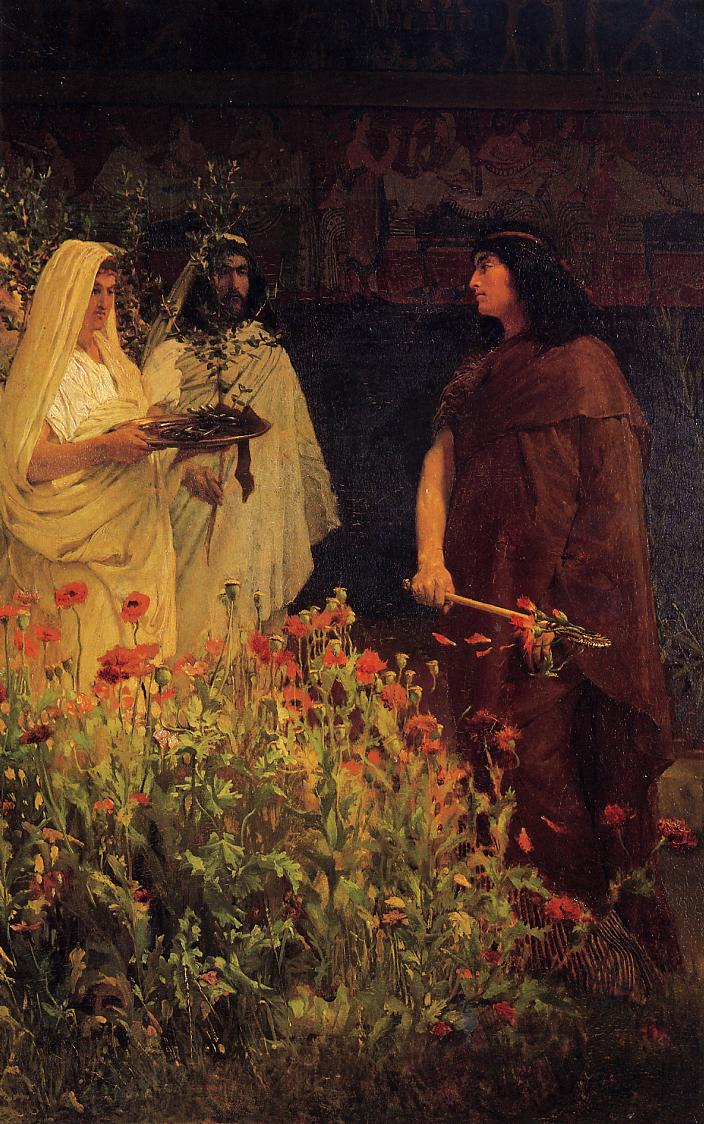
The specific reference to poppies occurs in Livy's account of the tyrannical Roman King, Tarquin the Proud. He is said to have received a messenger from his son Sextus Tarquinius asking what he should do next in Gabii, since he had become all-powerful there. Rather than answering the messenger verbally, Tarquin went into his garden, took a stick, and symbolically swept it across his garden, thus cutting off the heads of the tallest poppies that were growing there. The messenger, tired of waiting for an answer, returned to Gabii and told Sextus what he had seen. Sextus realised that his father wished him to put to death all of the most eminent people of Gabii, which he then did." 

That's why, for the Kremlin, besides trying to prop the legitimacy of the Poroshenko Nazi-oligarchic regime, its other urgent task was to recall Strelkov, a hero of our time, and make sure that he does not return and grow even higher. That's also why, if we look around Putin, we see people like Surkov, Medvedev, or Medvedchuk, with the latter two deserving to be called in conformity with the name of the last one "bears, but little ones."

Hopefully, Putin the aging oil and gas monarch, is not Medea's father .... and Alina Kabaeva is not Medea  She did come very close to set fire to the cauldron at the Olympic Games in Sochi, though, just when the US was busy pulling off the Maidan coup in Kiev--just over 400 miles from Moscow: "Rumors that Kabaeva might light the cauldron grew so loud this week that Putin addressed the topic, calling it a “red herring” and insisting he would play no part in naming the torchbearers. [In the end], Kabaeva didn’t get the honor of lighting the cauldron ..." Kabaeva merely brought the Promethean light unto the Stadium and their handed it over to the last pair of the torchbearers. 


I Ching on Vladimir Putin and Barack Obama (See what happens when a Czech poet dares to ask)

So what do Chinese think abut Putin or, at least, the oracle of I Ching?

The oracle says:
The Flood rises above the tallest Tree. Any direction is better than where you now stand. Like two atoms seeking to occupy the same space, these irresistible forces and immovable objects threaten to ignite a cataclysm that could irreversibly alter your world. This is no time for fatal heroics. You are at Ground Point Zero.
Remove yourself from this situation without delay.
The supporting beam is bending to its breaking point. Disaster looms.
A Dead Sea, its Waters spent eons ago, more deadly than the desert surrounding it: Action prevails where words will fail. You have exhausted every alternative, spent yourself completely, taxed body and mind beyond your former limits.
Survival and salvation lie beyond your reach now. The Old You is just a dry husk. You can't return to it. Metamorphosis is the only grace offered. (Hexagrams 28 and 47)

 For the sake of justice and equal treatment, here is what the I Ching oracle said in my hands about Obama.

While the oracle tries to address itself to a "Superior Person," one has to bear in mind that Obama is not "a Superior Person."

With this in mind, Obama is thus described as an unfaithful and neglected wife, who lacks "a healthy respect for the ripple effects of her/his words and deeds":
To some he serves as a role model. As such, he was in a position to "either help shape the world or tilt it into chaos."
We do know which of the two roads Obama has taken.
 Obama is tilting the world into chaos.
This, I take, is the most salient message from the oracle, which would seem obvious, but it is also good to have one's opinion confirmed by a higher authority ...
As a man who is tilting the world's axis into chaos, Obama is an instrument of the dense storm clouds gathering from the West. But there is still no thunderbolt and no rain. While the storm is building, Obama, the unfaithful wife, focuses on "fine tuning the image he/she presents to the world."
As such, he is assuming a position of a Tantalus stuck in the underworld. All he wants is always so near and yet always slipping and eluding at the same time. Inferior men like him "have gone mad from such [tantalizing] anticipation."
Only the Fates are restraining a man who has lost all his other restraints within.In the absence of grace not granted to him, he is bent on trying to fix the image and pose he is striking against the air and the waters he is submerging into.
The bottom line: Obama is a sidekick of chaos (that's his affair, so to speak) and, in doing so, he is going mad. (Hexagrams 37 and 9)


Note: I Ching does not respond well to spin, projections, presumption, and egos' heavy-handedness.